

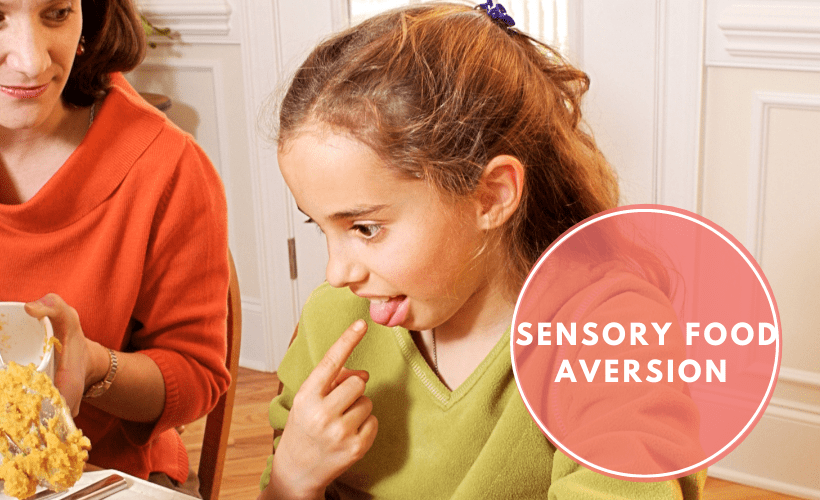
Sensory food aversion is professional jargon you may hear as you seek to understand the difficulties you are facing in feeding your child. This post is about helping you understand what sensory food aversion is. It will give you some tips on how to manage it best and explain when you need professional help as well.
Understanding Sensory Food Aversion
The easiest way to understand sensory food aversion is to consider food that made us sick. It is very likely that we will struggle to eat this food again for quite some time. The thought of the culprit food disgusts us, we can see it, smell it or even feel it. Older children tell me when they ate food, subsequently vomited it, and have since refused to eat it. Children can internalize negative eating experiences and rule out specific foods just like that.
Of course, I cannot skip the example of my sister (and I to a lesser extent) gagging and dry retching to the smell of boiled milk and the skin that forms on top of it. Neither of us got over this difficulty growing up, but we learned coping mechanisms, which I talk about later in this piece. Then homogenised milk came to the rescue: what a bliss!

Children who struggle with the sensory qualities of a food may have a meltdown, grimace, gag, dry retch, vomit and refuse all foods that have similar qualities. For example, they may struggle with mushy food and be much more comfortable with crunchy food. They may become reliant on packaged food that limits sensory surprises. They may differentiate two different vanilla yogurts that look and taste pretty much the same to you.
When children drop entire food groups as a result of a sensory food aversion they may become nutritionally deficient in protein, zinc, iron, Vit B12, C, etc. Growth and development may be affected as well.
Children who struggle with the sensory qualities of food may have oral-motor and expressive speech delays as well (Speech and eating muscle groups are the same). It is a bit of a catch 22, as they refuse challenging foods they are not learning the oral-motor skills they need to tackle them.
They may develop extreme anxiety around food. Typically I see babies or toddlers who are reactive, have a flight or fight response, then school-aged children who are anxious about what food they will find when they eat somewhere else, older children whose fussy eating is now very much part of their identity. Early intervention is key to limit the compounding effects of these difficulties.
Sensory Food Aversions are Common
So yes, food is sensory in nature: it has an appearance, a smell, a texture, and a temperature. Anyone can struggle with consuming food in any of these categories. Sensory food aversions are common and occur on a continuum[1].
Children who were born premature, children with hypersensitivities in other areas (for example children who do not like to get messy, or who are sensitive to clothing, or noise), and children with autism are more likely to have sensory sensitivities.
Severity of Sensory Food Aversion and Autism
Parents who have a child with ASD will often comment on their heightened sensory difficulties when it comes to food and eating. One can say that in terms of the continuum of sensory food aversions, children with ASD can be on the more extreme side. That can be partly explained because there can be many sensory difficulties that occur in autism. Read more here about our sensory systems here.
Strategies for parents
The impact of sensory food aversion on children and their families is important and may be long-lasting. Families experience stress, face a lack of understanding from friends, family, and even professionals. It is important parents understand they cannot reason a child out of sensory sensitivities. This has nothing to do with logic, no amount of persuasion will do the trick. Their child is not being oppositional, or disobedient for the sake of it. It is best parents try to identify sensitivities and aim to understand how they may feel. If anything this piece will enable parents to develop some understanding and empathy so they can best support their children.
Coming back to the milk example I gave earlier. If our parents ever told us to get over it or laughed at my sister being so “precious” with milk, they were mistaken. Please know it did not help one bit!
For children who have mild difficulties parents can:
-
Make sure mealtimes are pleasant and without pressure.
-
Serve liked foods with a small quantity of challenging food. Consider family-style of serving.
-
Help children explore food during cooking and play activities.
- Help children develop coping mechanisms. For example, smells may be managed. Children can learn to use the exhaust fan or open windows. Coming back one last time to the milk example, what helped us as children was to learn strategies. For example, we taught ourselves to heat the milk just under its boiling point (texture/smell), we used a strainer (texture), and mixed the milk (with chocolate powder) to lower the intensity of its smell and taste. Homogenised milk further solved our problem!
For children who have more severe difficulties parents can:
Consider the above and seek support. Often parents will need help with more severe forms of sensory food aversions because a thorough understanding of what is happening, and a long-term plan are needed. If you are unsure what type of help is available why not book a FREE 15min assessment here.
FAQ
Remove all pressure, create certainty with mealtimes, provide food familiarisation to reduce sensory hypersensitivities, reduce and eliminate fight, flight, freeze responses.
A sensory-based food aversion is when a child avoids certain foods because the texture, smell, taste, temperature, or appearance feels overwhelming or uncomfortable to their nervous system.
It’s not about being “fussy”—it’s a genuine sensory reaction where the food feels too much or too intense. This can lead to gagging, refusing, or becoming distressed when the food is offered or even seen.
Yes, many autistic people have strong reactions to food textures, smells, or tastes, causing selective eating.
Sensory food aversion is when a child (or adult) avoids certain foods because the texture, smell, taste, temperature, or appearance feels overwhelming or “too much” for their nervous system. It’s not fussiness — it’s a sensory overload response.
A child might gag from a smell, refuse foods that feel “wrong” in their mouth, or only tolerate very specific textures. It’s a genuine sensory-based reaction, not a behaviour choice.
Food chaining is a specialised, clinical approach and should only be done by practitioners trained in that method. Parents often feel like they’re “doing food chaining” at home, but in reality the true process is far more structured and therapist-led.
In my work, I don’t use classic food chaining, but I do help families notice patterns in the foods their child already accepts — such as similar textures, flavours, temperatures, or shapes. These “common threads” can gently support a child to try small, manageable extensions of their current foods.
This is not food chaining, but a guided, child-centred way of stretching comfort zones without overwhelming a sensory-sensitive eater.
Yes. Keeping familiar foods in the mealtime routine supports a child’s sense of safety and helps them stay regulated. In my approach, meals are viewed as systems — predictable setups that allow children to feed themselves well, feel calm, and trust that they can meet their needs.
New foods can be present in the environment without being pushed, mixed, or placed on the child’s plate unless they choose it. The goal isn’t to make them eat the new food, but to maintain a system where they feel confident and in control.
Yes, in some cases. When sensory avoidance significantly restricts the diet, children may be at higher risk of missing nutrients such as iron, zinc, or some vitamins. Not all children with sensory aversion experience deficiencies, but close monitoring of growth and intake is recommended, especially if only a few foods are accepted.