

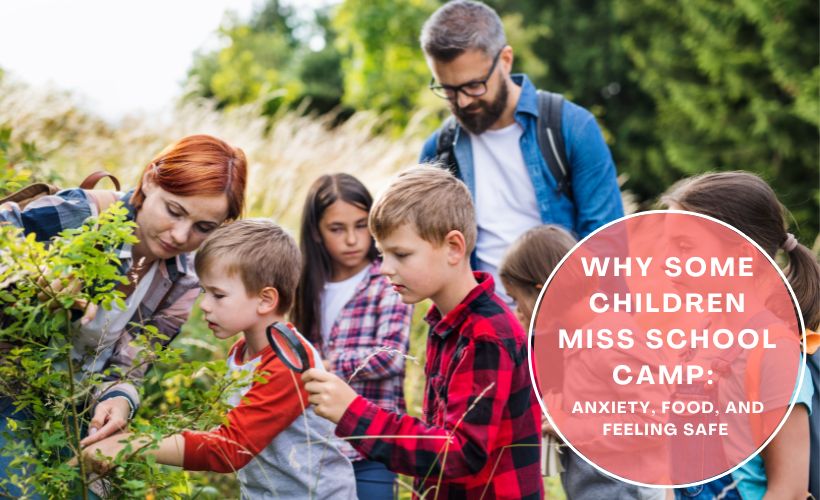
Reports on Australian morning television today highlighted a growing issue. Increasing numbers of children are refusing to attend school camps because of anxiety, leaving many parents and teachers wondering what is really driving this change.
For many families this can feel confusing or frustrating. Camps are meant to be exciting milestones. In beautiful Australian locations, children build stronger connections with friends and teachers while developing independence and lasting memories.
But for some children, the idea of a few nights away from home can feel overwhelming.
When we look a little closer, another factor often sits quietly in the background. Food.
The hidden worry: “What am I going to be able to eat?”
For children who struggle with extreme fussy eating or restrictive eating, school camp can feel like stepping into the unknown.
At home, they know exactly what foods are available and how meals work. At camp, that certainty disappears.
Children may worry about:
- Not having any foods they can eat
- Being pressured to try unfamiliar foods
- Other children noticing what they do or do not eat
- Feeling hungry for days
- Adults misunderstanding their refusal
For a child whose eating already feels difficult, these worries can be enough to trigger strong anxiety about attending camp at all.
Anxiety and eating are closely linked
Many children with very limited diets are not simply being picky. Their nervous system may react strongly to unfamiliar foods, smells, textures, or social pressure around eating.
When the brain senses threat, whether that threat is real or perceived, the body shifts into a stress response. Appetite shuts down and the child’s focus moves to safety rather than eating.
Now imagine that same child placed in a completely new environment, surrounded by unfamiliar foods and people. For some children, their brain quickly decides that this does not feel safe.
Avoiding camp becomes the simplest way to avoid that feeling.
When eating difficulties are part of the picture
Some children with very restricted diets may meet criteria for Avoidant Restrictive Food Intake Disorder, often called ARFID. Others may not have a diagnosis but still experience significant anxiety around food.
These children are often highly aware of their eating differences. Being in a group setting where meals are shared and noticed by others can feel stressful and exposing.
For them, camp is not just about sleeping away from home. It is also about facing several days of food uncertainty.
It is not about “being difficult”
When children refuse camp, adults sometimes interpret this as stubbornness or lack of resilience. But many of these children want to go. They want to be with their friends and share the experience.
The problem is that the combination of separation from parents, new environments, social expectations, and unfamiliar food can push their nervous system into overload.
For children who already struggle with eating, food uncertainty can become the tipping point.
Supporting children while building resilience
At the same time, simply dismissing a child’s anxiety or avoiding the situation entirely is rarely helpful. Telling a child to “just go” can increase distress, but removing every challenge can also reinforce the belief that the situation is unsafe. What children need instead is support that helps them build resilience. This means acknowledging their worries while gradually helping them face new experiences with preparation, reassurance, and practical strategies. When children feel understood and supported, they are far more likely to develop the confidence needed to manage both unfamiliar food and new environments.
Short-term support: helping children attend camp
When schools and parents understand the role food may play, simple adjustments can make a big difference.
- Allowing children to bring familiar foods from home
- Sharing camp menus in advance
- Reassuring children they will not be forced to eat
- Offering quiet alternatives if meals feel overwhelming
- Focusing first on helping children feel safe
When the nervous system feels calmer, many children become far more willing to participate.
Longer-term support: building confidence around food
Alongside practical accommodations, children also benefit from longer-term support that helps them become more confident and resilient around food.
In my work, this often involves coaching parents so they can support their child in gradually building the skills needed to manage food more independently. Children learn to increase their comfort with different foods, develop practical eating skills, and build problem-solving abilities around meals.
Over time, this helps children feel more capable in unfamiliar environments. The goal is that the next time they attend camp, they are more comfortable navigating meals and able to feed themselves successfully without needing to rely entirely on outside food.
Camp should feel possible
School camps are valuable experiences. But for some children, getting there requires understanding the challenges they carry, including those that show up around food.
By recognising the link between anxiety and eating, we can help more children feel able to take part instead of missing out on experiences that matter to them.
As a clinician working with children who struggle with extreme fussy eating and food anxiety, I often hear from families whose children miss school camps for this very reason. These children are not trying to be difficult. Their nervous system is responding to a situation that feels unpredictable and unsafe, especially around food. When adults understand this and provide reassurance, flexibility, and practical support, many children are able to gradually participate in experiences that once felt impossible. With the right support, confidence around food and new environments can grow together.
