

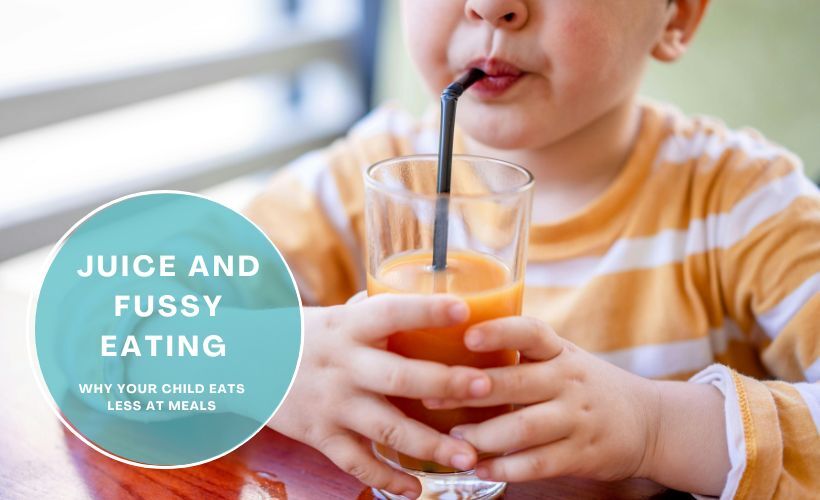
If you have a fussy eater, chances are juice has become part of your routine.
It can feel like a small win:
- They sit at the table
- They are calm
- They are having something
But many parents start to notice a pattern:
- Their child drinks the juice quickly
- Eats very little
- Then says they are hungry not long after
Let’s unpack why this happens and what you can do instead.
“But It’s 100% Fruit Juice…”
Juice is often marketed as a healthy choice.
It says:
- “100% fruit”
- “No added sugar”
- “Contains vitamin C”
And yes, that can all be true.
But juice is not the same as whole fruit.
What’s Missing? The Fibre
When fruit is turned into juice, most of the fibre is removed.
Fibre is what:
- Helps kids feel full
- Slows down sugar absorption
- Supports gut health
Without fibre, the natural sugars in juice are absorbed quickly.
So even though it comes from fruit, juice behaves more like a quick sugar hit than a filling part of a meal.
What About Vitamin C?
Juice often still contains vitamin C:
- Some is naturally retained during processing
- Some is added back in
So yes, your child may be getting vitamin C.
But they are getting it without the fullness and balance that comes with eating real fruit.
What Happens at the Table
When a child drinks juice during a meal:
1. They fill up quickly
Sweet drinks can take the edge off hunger.
For a fussy eater, that often means just a few bites of food.
2. Energy spikes then drops
Juice is absorbed quickly, leading to:
- A short burst of energy
- Followed by a dip
This often looks like:
- Hunger soon after the meal
- More snacking requests
3. It nudges food preferences
Children are naturally drawn to sweet tastes. This is not bad behaviour. It is biology.
From infancy, humans show a preference for sweetness because it signals energy and safety. This preference is not fixed and is shaped through repeated experience.
When juice is a regular part of meals, several things can happen:
Sweet taste becomes the baseline
Repeated exposure to sweet drinks can shift what a child expects food to taste like.
Foods that are less sweet, such as vegetables, proteins, or mixed dishes, may feel less rewarding in comparison. Over time, this can reduce willingness to engage with those foods.
Learning happens through repetition
Children learn what to like through exposure.
- Repeated exposure increases acceptance
- It also reinforces existing preferences
If sweet flavours are consistently present, they become the most familiar and preferred.
Associations form at the table
Children learn patterns, not just flavours.
If juice is always part of meals:
- Mealtimes become associated with sweetness
- Neutral or complex foods may feel less satisfying
- Children may look for the predictable option first
What does the research say?
- Repeated exposure increases liking, especially for sweet tastes (Ventura & Mennella, 2011, Appetite)
- Food preferences are shaped by biology and repeated exposure (Birch & Doub, 2014, Annals of Nutrition and Metabolism)
- Higher intake of sugary drinks is associated with poorer diet quality in children (Johnson et al., 2017, Pediatrics)
- Guidance from the World Health Organization and American Academy of Pediatrics recommends limiting juice because of its impact on diet quality and taste development
The Bigger Picture
If your child struggles with food, juice is not the main issue.
Fussy eating is usually driven by:
- Sensory sensitivities
- Anxiety about new foods
- A need for predictability
Juice interacts with this by:
- Reducing hunger at key moments
- Making it easier to stay within safe, familiar options
An Important Nuance
For some children with very limited diets, juice can play a helpful role.
If a child is eating little to no fruit or vegetables:
- A small amount of juice, especially if vitamin C fortified, can support basic nutrition
- This can be useful in the short term while food variety is slowly expanding
This is where quantity and timing matter.
What Can Help Instead
You do not need to remove juice completely.
Small, gentle changes work best.
Try this:
- Offer water with meals
- Serve juice with breakfast only
This helps your child:
- Come to the table hungry
- Stay more regulated
- Be more open to trying food
A Reassuring Note
If juice has become part of your routine, you have not done anything wrong.
You have been:
- Reducing stress
- Supporting your child
- Getting through tough moments
That matters.
The Takeaway
Even when it is “100% fruit,” juice:
- Lacks fibre
- Fills kids up quickly
- Can reduce intake at meals
- Increase hunger shorty after meals
But in some cases, small amounts can support nutrition.
The goal is not to remove juice completely, but to use it in a way that supports your child’s overall eating.
Think of it as one small lever you can gently adjust.